
David C Mulford, who will soon vacate his post as United States'ambassador to India, has urged the Obama administration to ensure the implementation of the India-US civilian nuclear agreement.In an interaction at the Carnegie Endowment for International Peace in Washington, Mulford said, "The nuclear deal may be completed, but the work isn't done. There is unfinished business there to be done."
India and Japan adopted a mutually acceptable stance, in Tokyo on Monday, to speed up negotiations on a civil nuclear agreement, resolving to bring it to fruition at the earliest.
President Barack Obama has sent the report on the Indo-US civilian nuclear deal to the US Congress, the White House said today.
Kimball had strongly opposed the deal in the past.
But the Bush Administration assured that the changes will be within the framework of the Joint Statement.

'As one might expect, he believed the Indians were preparing their nuclear weapons for deployment. It took us a few hours - and remarkably good work by our teams on the ground in New Delhi and Islamabad - to convince each side that the other was not preparing for nuclear war'
Dr Kasturirangan said signing of the nuclear deal was for India's good.
In a statement a couple of days ago, the business chamber said, 'The Indo-US civilian nuclear initiative will bring India into the international nuclear non-proliferation mainstream and enhance the safety of India's civil program. The initiative will also help to revitalize the US nuclear industry and create thousands of high-tech American jobs.'
Companies like GE and Westinghouse, eager to help meet India's huge energy demand, are on the sidelines while France and Russia win business.
India on Friday said it was confident of the passage of the Indo-US civil nuclear deal as it enjoyed bipartisan support among lawmakers, assuring that American firms would not be put at a disadvantage even if there is delay in getting a Congressional nod for the accord.
India on Friday expressed confidence that its nuclear deal with the United States would win US Congress approval following the Bush administration's pledge to support a bi-partisan legislation on the pact.

The beauty of the relationship between the two countries is that they agree to disagree and perhaps that is the strongest bond between the two governments and their relationships, notes Rup Narayan Das.
US Secretary of State Condoleezza Rice met Minister of State for External Affairs Anand Sharma late Wednesday night on the sidelines of ASEAN ministerial meet in Singapore. The leaders had a 'very good' meeting during which Rice appreciated India's 'resolve to go ahead with the historic nuclear deal', highly-placed sources told PTI.
To a question on continuing support to the government, Karat said he has just talked to Prime Minister Manmohan Singh and UPA chairperson Sonia Gandhi and it depends on what they decide.
The SP leader said he endorsed the stand taken by his party's parliamentary group leader Ram Gopal Yadav that Prime Minister Manmohan Singh was an honourable person, but the deal he is pursuing with the United States was not an honourable one.
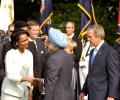
The night before Dr Singh was to meet President Bush, he said he could not sign the agreement.
the Opposition on Thursday demanded a passage of a resolution in the Rajya Sabha to reflect the sense of Parliament that country's nuclear and strategic autonomy is not compromised.
Eminent economist Lord Meghnad Desai on Wednesday came out strongly against moves to stall the India-United States nuclear agreement and claimed that if the deal did not go through, it would be a severe blow to India's international standing.Terming the pressure tactics by the Left as disgraceful, Lord Desai said that it was tragic that the United Progressive Alliance government was losing its nerve (on the nuclear deal).
Singh accepted Bush's invitation to visit the US again and said a mutually convenient date would be worked out.
The Post report noted that US officials are saying that 'India has made unrealistic demands, such as retaining the right to test nuclear weapons.'
He maintained that India cannot undertake any obligations going beyond the July 18 Joint Statement and the Separation Plan.
The Bharatiya Janata Party has asked Prime Minister Manmohan Singh and his government to tender an apology to the nation and explain why it mislead the country on the nuclear deal.
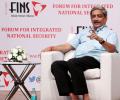
Former NSA Shivshankar Menon said the defence minister did not have a right to voice his personal opinion on nuclear policy in public, particularly when that opinion contradicted the country's official policy.
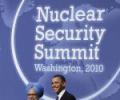
A frustrated and angry America Inc believes it has been let down by Delhi after all of its lobbying to push through the deal in the US Congress, reports Aziz Haniffa in Washington, DC.

'Decisions on nuclear power have so far been taken by a small select group, primarily interested in profiteering from their actions, stating 'secrecy' as necessary from the national security point.' 'This argument is false, because we are dealing with the 'civilian' nuclear power sector, which is open even to the IAEA,' says Dr A Gopalakrishnan, former chairman of the Atomic Energy Regulatory Board.
L K Advani on Thursday said he would have no objection to the signing of the much debated nuclear deal with the United States if it was renegotiated to allow the option of further nuclear testing.
US Undersecretary of State for Political Affairs Nicholas Burns will resign, a senior US official said on Friday.
The influential Indian-American community has swung back to action to push the N-deal ahead.
An authoritative and well-connected strategic affairs journal in China has come out with a prompt independent comment on the progress in the N-deal.
Emphasising that the India-US nuclear agreement is in the interest of both the countries, Richard Boucher, the top official in charge of South and Central Asia, hoped that the deal will continue towards implementation.
"The protest by the Left is a reflection of their ideology. It is inappropriate," Nath said in Chhindwara, his Lok Sabha constituency.
The nuclear-deal-in-the-making with the US has forced the government into a firefighting mode not only domestically, but also internationally, where it is working overtime to avoid straining relations with the key long-time ally -- Russia.
"Stronger economic, scientific, diplomatic, and military cooperation between the US and India is in the national interest of both countries and reflects our increasingly close relationship with this important democratic ally," Ranking member on the House of Foreign Affairs Committee, Ileana Ros-Lehtinen, said.
